
Medical device · Product 01
iNO-VEN
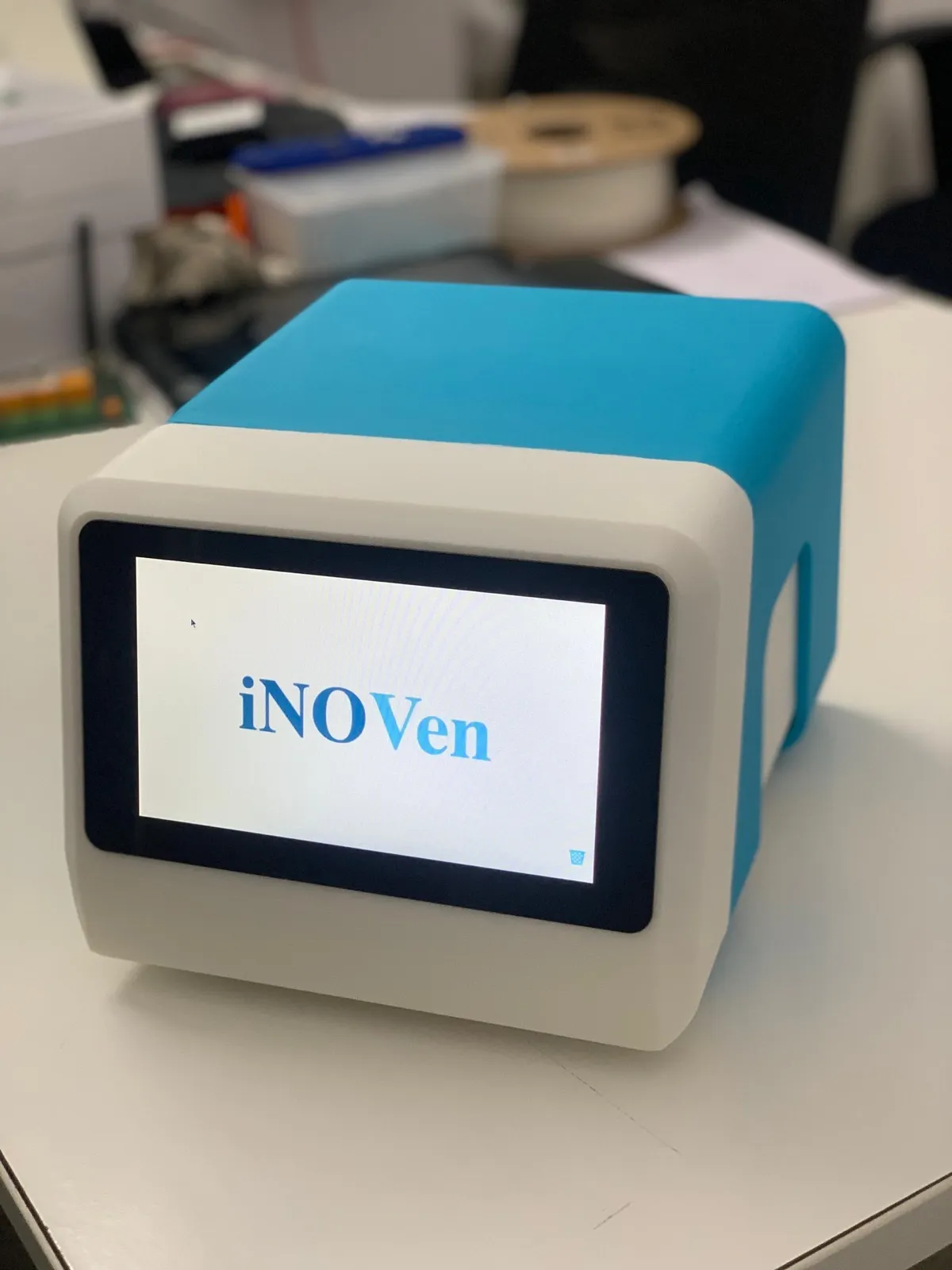
India's first indigenous inhaled nitric oxide delivery and monitoring system. Life-saving iNO therapy for every NICU, PICU and ICU — portable, precise, and at a fraction of the cost of imported systems.
01 The problem
A life-saving therapy,
out of reach.
Inhaled nitric oxide is a proven, internationally recognised treatment for Persistent Pulmonary Hypertension of the Newborn (PPHN), hypoxic respiratory failure, Acute Respiratory Distress Syndrome (ARDS) and Pulmonary Arterial Hypertension (PAH). In clinical practice it rapidly dilates the pulmonary vasculature, reduces the need for ECMO, and saves newborn lives.
Yet in India and across low- and middle-income countries, iNO therapy remains out of reach for the vast majority of patients who need it.
Why is access so limited?
- Imported iNO devices cost ₹50–80 lakhs — beyond the reach of most Indian hospitals.
- Bulky, non-portable systems confined to a handful of tertiary care centres.
- Complex setup requiring specialised technicians and extensive staff training.
- No indigenously manufactured, CDSCO-approved alternative existed — until now.
02 The solution
Introducing
iNO-VEN.
A compact, intelligent and affordable inhaled nitric oxide delivery and monitoring system — designed from the ground up in India, for India, and for the world.
Developed by a multidisciplinary team of neonatologists and biomedical engineers at VEHA Health Care Education LLP in Hyderabad, iNO-VEN integrates precision gas delivery, real-time electrochemical monitoring and a clinician-friendly touchscreen into a single battery-operated bedside device.
It is engineered to work across neonatal, paediatric and adult critical care — making it the most versatile iNO system available in India.
03 Capabilities
What makes iNO-VEN different
Affordable
Priced over 70% below imported systems without compromising safety, accuracy or monitoring. Cost is treated as a design constraint from the first schematic.
Intuitive interface
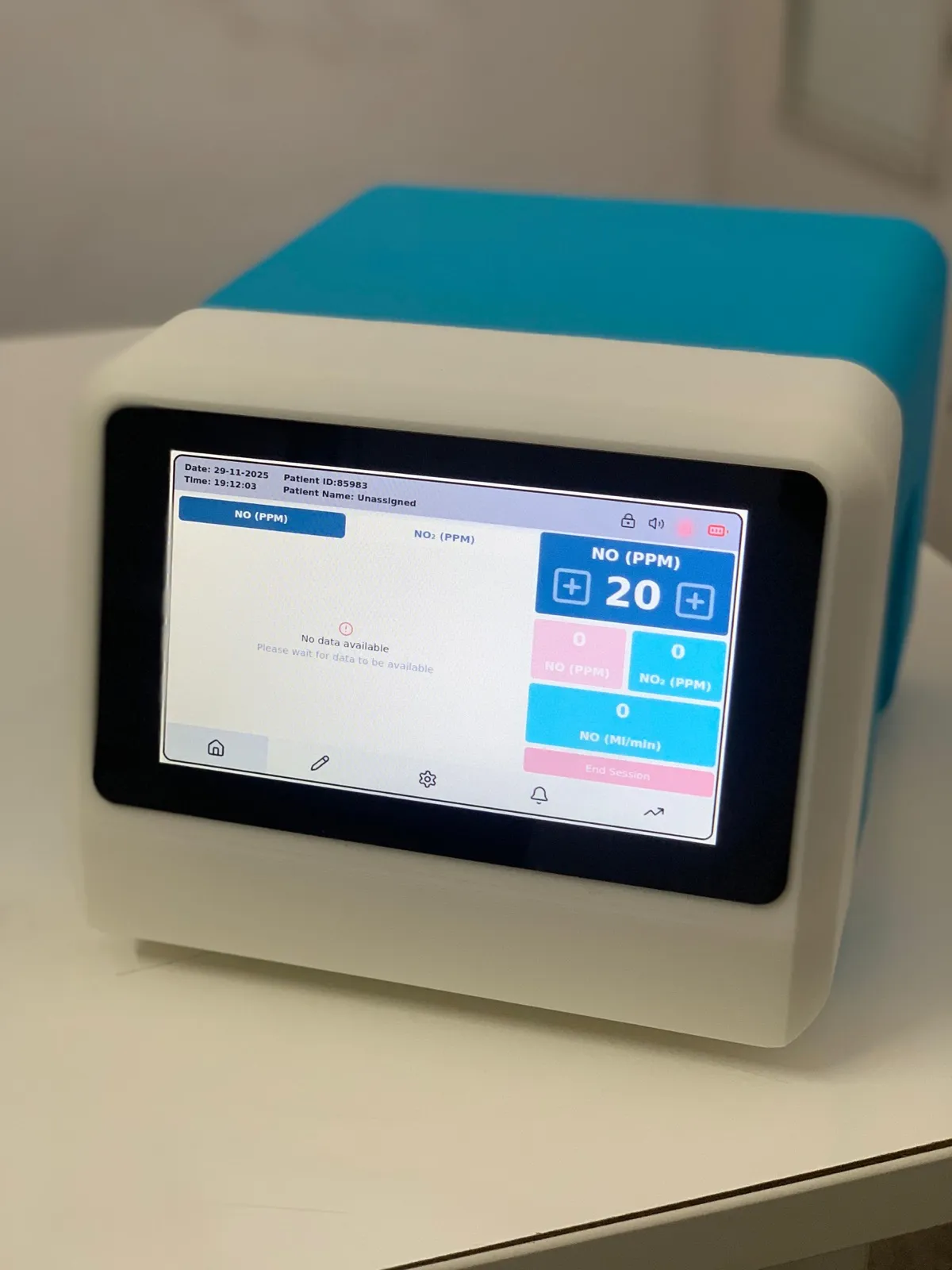
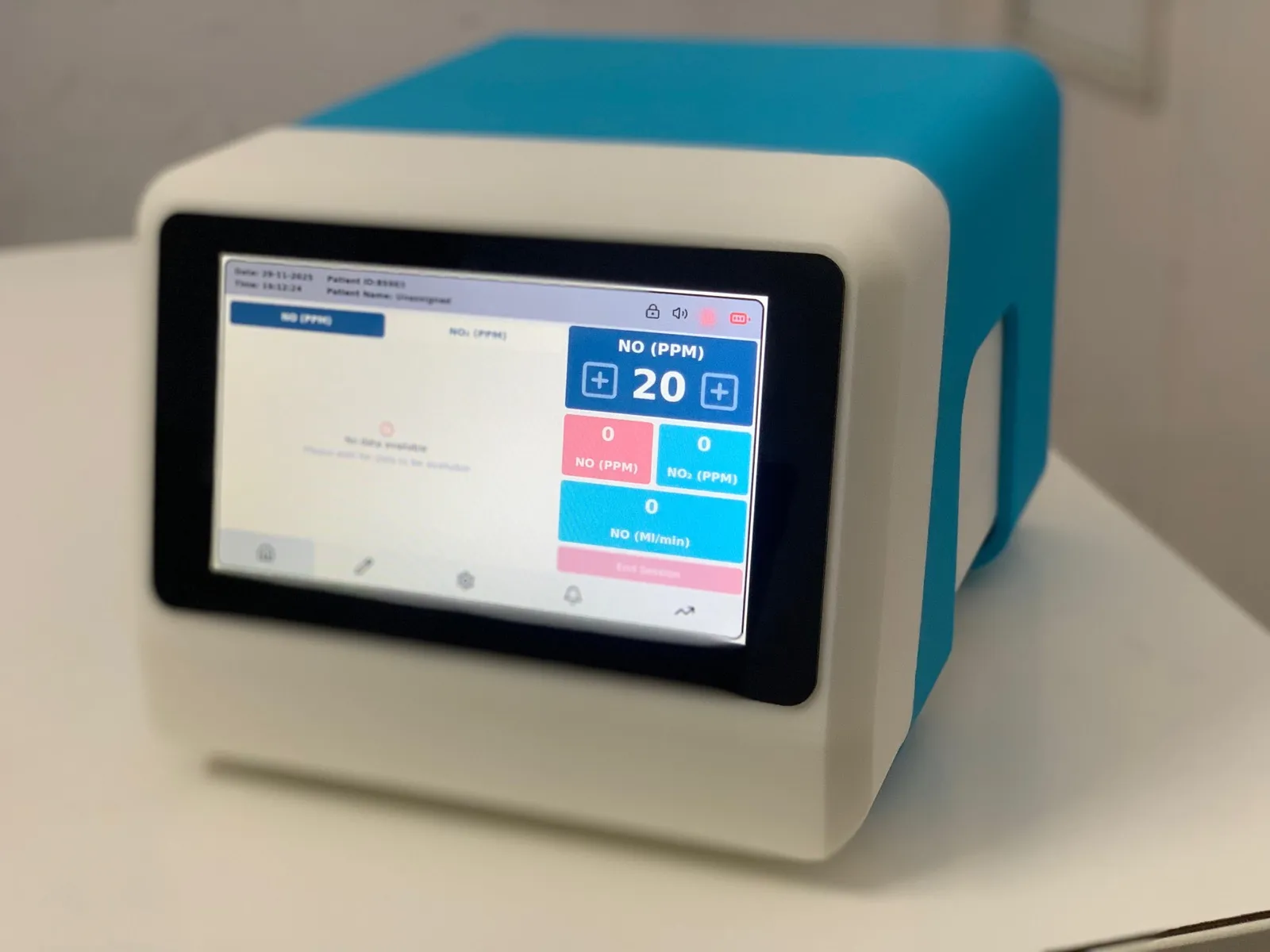
7″ colour TFT touchscreen with day and night modes. Operable after under 30 minutes of training, with clear alarms, trend displays and one-touch calibration.
Truly portable
260 × 200 × 160 mm and about 4 kg, with an integrated 14.8V/5Ah battery giving 4–6 hours of uninterrupted backup. Bedside to bedside, ward to ward.
Precision dosing
Delivers 0–80 ppm with bench-tested accuracy of ±0.5 ppm, with automatic safety shutoff if NO₂ exceeds safe limits.
Real-time monitoring
Continuous electrochemical sensing of NO (0–100 ppm) and NO₂ (0–10 ppm) with IEC 60601-1-8 compliant audible and 360° visual alarms. 72-hour trend storage, CSV/PDF export.
Universal compatibility
Works with all standard neonatal, paediatric and adult ventilators. No proprietary circuits — it fits the ventilator infrastructure a unit already owns.
Safety first
Seamless battery switchover in under 10 ms on mains failure. Automatic high-NO₂ cutoff above 3 ppm. Cylinder low-pressure alarms below 30 bar. Patient leakage under 100 µA.
Made in India
Indigenously designed under an ISO 13485:2016 QMS. Patent filed with the Indian Patent Office. CDSCO Class C/D regulatory submission in progress.
04 How it works
Five precision modules,
one bedside device.
From cylinder to ventilator circuit to trend log — every stage instrumented, every stage alarmed.
- 01
Gas source interface
Connects to a standard NO gas cylinder (20 ppm NO in N₂). An inline pressure regulator reduces cylinder pressure to safe working levels, with real-time pressure monitoring and automatic low-gas alarms.
- 02
Precision dose regulator
A proportional solenoid valve (electronically controlled) or a dual-scale cascaded rotameter (manual backup) delivers the prescribed dose at ±0.5 ppm across the therapeutic range of 0–40 ppm.
- 03
Ventilator-compatible delivery
iNO is injected directly into the inspiratory limb of the patient's ventilator circuit via a sterile single-use adapter, compatible with all standard ventilators from neonatal through adult.
- 04
Real-time sensor assembly
Electrochemical sensors continuously measure delivered NO (0–100 ppm) and NO₂ (0–10 ppm) in the gas stream. Automatic safety shutoff activates if NO₂ exceeds 3 ppm.
- 05
Digital display & data logging
A 7″ colour touchscreen shows live NO/NO₂ readings, alarm status, battery level, cylinder pressure and 72-hour trend graphs. All data exports via USB as CSV or PDF for clinical records.
05 Clinical evidence
Clinically validated.
Peer-recognised.
iNO-VEN has been developed and tested against rigorous clinical and engineering standards. The prototype has undergone bench testing for dose accuracy, flow stability, alarm responsiveness and ventilator compatibility.
Prototype testing demonstrated delivery accuracy within ±0.5 ppm across neonatal and paediatric ventilation ranges. The interface was usable by NICU staff after under 30 minutes of training. Manufacturing cost analysis showed a greater than 70% reduction compared with current market devices.
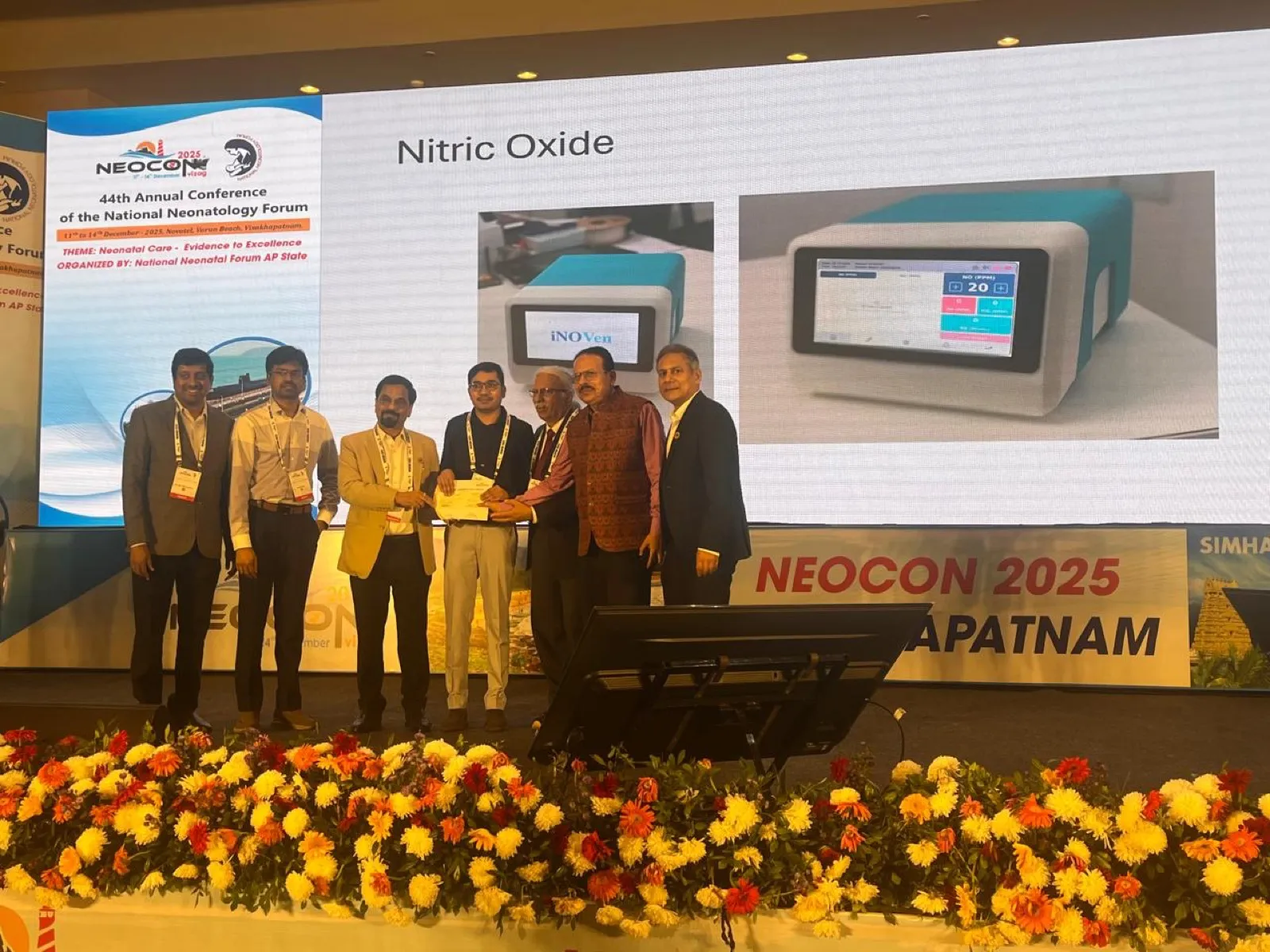
iNO-VEN abstract — NEOCON, National Neonatology Conference, India
Regulatory & standards pathway
- CDSCO Class C/D medical device — regulatory submission in progress
- CE Mark Class IIb/III pathway — international regulatory roadmap underway
- ISO 13485:2016 Quality Management System — implemented, under certification
- ISO 14971:2019 risk management — applied across all design controls
- IEC 60601-1 electrical safety, 60601-1-2 EMC, 60601-1-8 alarms
- Indian patent filed — Nitric Oxide Therapy Machine, Indian Patent Office
- iNO-VEN trademark (Class 10) — registered with Intellectual Property India
06 Technical specifications
The numbers,
in full.
Display & interface
| Display | 7″ real colour TFT touchscreen (day & night modes) |
|---|---|
| Resolution | 800×480 or 1024×600 |
| Data storage | 72 hours trend data — CSV/PDF export via USB |
| Connectivity | USB external port for data transfer and firmware updates |
Gas delivery
| Dosing range | 0–80 ppm (automated) | 0–1000 mL/min (manual rotameter) |
|---|---|
| Dose accuracy | ±0.5 ppm (bench tested) |
| Control method | Proportional solenoid valve (Model A, automated) + manual rotameter backup (Model M) |
| Gas source | Standard NO/N₂ calibration cylinder (CGA-660 compatible) |
Monitoring
| NO sensor range | 0–100 ppm | resolution 0.1 ppm | T90 < 45 s |
|---|---|
| NO₂ sensor range | 0–10 ppm | resolution 0.1 ppm | T90 < 45 s |
| Safety cutoff | Automatic shutoff if NO₂ > 3 ppm |
| Cylinder alarm | Low pressure < 30 bar | critical empty < 10 bar |
Power
| Mains input | 100–240 VAC / 50–60 Hz (universal) |
|---|---|
| Battery | 14.8V / 5Ah Li-Ion (4S), medical grade |
| Battery backup | 4–6 hours typical operating time |
| Switchover | Seamless MOSFET OR-ing — under 10 ms interruption on mains failure |
Physical
| Dimensions | 260 mm (W) × 200 mm (H) × 160 mm (D) |
|---|---|
| Weight | Approx. 4.0 kg |
| Ingress protection | IP21 (minimum) |
| Alarms | Audible > 70 dB at 1 m + 360° visual LED bar |
07 Market & impact
Who benefits
from iNO-VEN?
NICUs — neonatal intensive care
PPHN, hypoxic respiratory failure and post-cardiac surgery in newborns — the primary indication. Only about 20% of eligible neonates currently receive iNO.
PICUs — paediatric intensive care
Paediatric ARDS and acute hypoxaemic respiratory failure — an underserved population with high mortality and limited access.
Adult ICUs & cardiac surgery
Adult ARDS, pulmonary hypertension and post-cardiac or lung surgery — extending iNO into high-volume adult critical care.
District & Tier-2 hospitals
Affordable pricing and simple training mean iNO therapy is no longer confined to premier tertiary centres.
Global LMICs
80% of the global PPHN and PAH burden falls on low- and middle-income countries where imported devices are unaffordable.
Market snapshot
08 Milestones
Our journey
- 2024
Concept & design
Multidisciplinary team formed. Architecture, block diagrams and the full technical specification developed.
- Dec 2024
Patent filed
Provisional patent application filed with the Indian Patent Office for the Nitric Oxide Therapy Machine.
- Dec 2024
Trademark registered
iNO-VEN trademark (Class 10) filed and accepted with Intellectual Property India.
- Early 2025
Working prototype
First working prototype assembled and bench-tested. Delivery accuracy of ±0.5 ppm confirmed.
- 2025
NEOCON presentation
Presented at the National Neonatology Conference, selected under the Innovations category.
- 2025–26
ISO 13485 QMS
Quality Management System implemented; ISO 13485:2016 certification process initiated.
- 2026
CDSCO submission
Regulatory submissions to CDSCO for Class C/D test licence and device approval — in progress.
- Q3–Q4 2026
Clinical validation
Planned clinical evaluation in partner NICUs and PICUs across India.
- 2027
Commercial launch
Target commercial launch — India first, followed by international markets.
09 The team
The team
behind iNO-VEN.
Born at the intersection of neonatal intensive care and biomedical engineering — a partnership that gives the device both clinical credibility and engineering rigour.

Founder, Director & Chief Medical Officer
Dr. Venkat Reddy Kallem
MBBS, DNB (Paediatrics), DrNB (Neonatology)
A practising neonatologist with over six years in neonatal critical care, experienced in managing PPHN and hypoxic respiratory failure. He founded VEHA to close the distance between what neonatal medicine can do and what an Indian NICU can actually reach for — and is the clinical author behind all four products.
Co-Founder & Biomedical Engineering Lead
Adithya Chilka
7+ years in healthcare IoT & medical device design
Former CTO at RapidCircuitry. Leads hardware architecture, electronics design and systems integration for iNO-VEN.
Hardware & Electronics Lead
Robin Samuel
7+ years in medical electronics & biosignal platforms
Specialist in medical electronics and biosignal evaluation platforms. Responsible for PCB design, power management and IO controller systems.
Firmware & Embedded Systems Lead
Saikumar Mandaji
5+ years in embedded systems programming
Leads firmware development for the IO controller board and MCU. Expert in real-time embedded systems for medical device applications.
Business Development & Operations Manager
Pallavi Deep
Healthcare business development
Manages business development, strategic partnerships, grant applications and operational workflows at VEHA Health Care Education LLP.
10 Questions
What exactly is iNO-VEN?
iNO-VEN is India's first indigenously designed inhaled nitric oxide delivery and monitoring system — a compact, battery-operated bedside device that delivers iNO from 0 to 80 ppm at ±0.5 ppm bench-tested accuracy, monitors NO and NO₂ continuously, and works with all standard neonatal, paediatric and adult ventilators.
How much cheaper is it than an imported system?
Manufacturing cost analysis showed a greater than 70% reduction compared with current market devices. Imported iNO systems typically cost ₹50–80 lakhs in India, which is why roughly 80% of eligible patients never receive the therapy.
Which conditions is iNO therapy used for?
Persistent Pulmonary Hypertension of the Newborn (PPHN), hypoxic respiratory failure, Acute Respiratory Distress Syndrome (ARDS) and Pulmonary Arterial Hypertension (PAH). iNO rapidly dilates the pulmonary vasculature and reduces the need for ECMO.
Is iNO-VEN approved for clinical use yet?
Not yet — iNO-VEN is an investigational device. A CDSCO Class C/D regulatory submission is in progress, an Indian patent has been filed, and ISO 13485:2016 certification is under way. Clinical validation in partner NICUs and PICUs is planned for Q3–Q4 2026, with commercial launch targeted for 2027.
How much training does the staff need?
In prototype testing the interface was usable by NICU staff after less than 30 minutes of training, with clear alarms, trend displays and one-touch calibration.
Does it need special ventilator circuits?
No. iNO is injected into the inspiratory limb of the existing ventilator circuit through a sterile single-use adapter. No proprietary circuits are required and it works with the ventilator infrastructure a unit already owns.
11 Get involved
Partner with us
in saving lives.
iNO-VEN is more than a device — it is a mission to democratise inhaled nitric oxide therapy across India and the developing world. We are seeking clinical evaluation partners, investors, OEM manufacturing partners and distribution networks.